A major media ownership shift is underway in the Balkans. EU Commitment to media pluralism faces a new challenge
BFMI position note
One of the last major independent media networks in the Western Balkans may be about to change hands. This is not just a business story. It is part of a wider shift in media ownership across Southeast Europe, and the first real moment when the European Media Freedom Act will have to prove its worth.
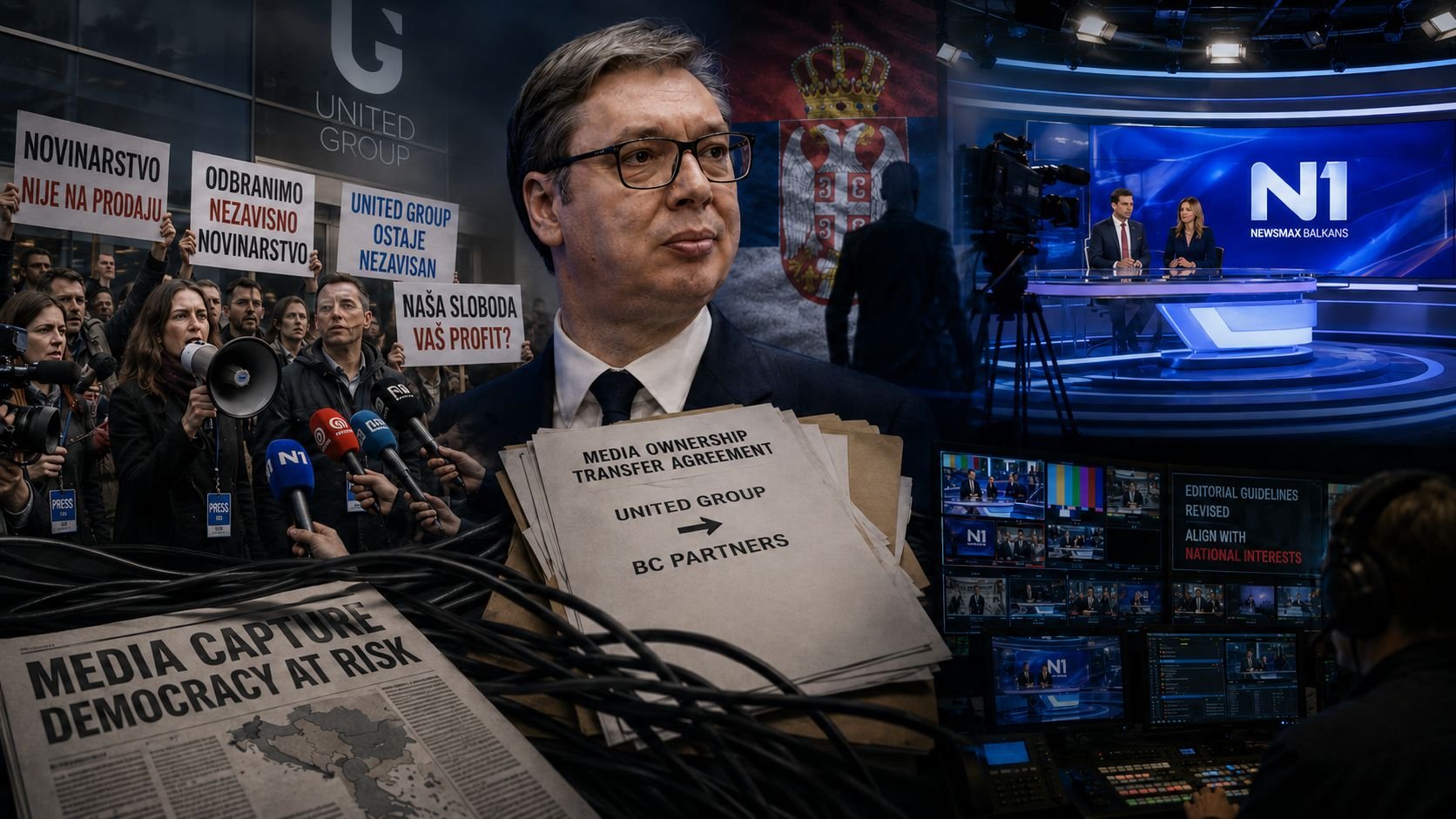
The reported sale concerns Adria News, the group behind N1 television in Serbia, Bosnia and Herzegovina and Croatia, as well as several other important outlets, including Danas, Nova S, Nova M, Nova.rs, Radar and a majority stake in Montenegro’s Vijesti. These are not marginal assets. For years, N1 has been one of the few television networks in Serbia willing to report critically on President Aleksandar Vučić and his government. In a media environment shaped by political pressure, state-linked advertising and ownership influence, N1 has remained one of the rare counterweights.
But the story may not stop there. Market conversations around other major media assets, including Nova TV in Bulgaria, suggest that the region may be entering a broader phase of ownership repositioning. Nova TV is one of Bulgaria’s most-watched broadcasters. Any movement around such an asset would have consequences far beyond one company or one national market. Together, these developments raise a larger question: who will control the channels through which millions in Southeast Europe receive news?
According to a leaked draft contract published by OCCRP and Raskrikavanje, United Group’s media assets are being prepared for sale to European Future Media Investments, a Luxembourg-based vehicle. The buyer’s contractual contacts reportedly point to figures linked to Alpac Capital, the Portuguese fund that acquired Euronews in 2022.
That earlier Euronews acquisition has already raised serious questions. Investigations by Le Monde, Direkt36 and Expresso found that the deal was financed in significant part by Hungarian state-linked capital and companies close to Viktor Orbán’s political communications ecosystem. BFMI warned at the time that this type of cross-border media investment can reshape fragile media markets without the public clearly knowing who is financing the transaction, who benefits from it, and what political interests may sit behind it.
The risk now is that a similar pattern could extend to one of the most important independent media networks in Southeast Europe.
On paper, the draft agreement reportedly includes commitments to editorial independence, European media pluralism standards and the creation of an independent advisory body. That may sound reassuring. But these promises matter only if they can be enforced. If there are no penalties for violating them, no clear protection for editors and journalists, no transparent procedures for appointing or dismissing newsroom leadership, and no real power for any advisory body to stop interference, then the safeguards are little more than comforting language.
Media capture today rarely begins with open censorship. It often begins with ownership changes, opaque financing, pressure on management, the quiet removal of trusted editorial leaders, and contracts that promise independence without making it defensible.
That is why this sale cannot be seen in isolation. In August 2025, OCCRP published a recording of a call between United Group CEO Stan Miller and Vladimir Lučić, the CEO of Serbia’s state-owned Telekom Srbija. In that call, the removal of Aleksandra Subotić, the long-time head of United Media, was discussed in connection with pressure from President Vučić. Subotić had been widely seen as a key guarantor of editorial independence inside the group. She was eventually dismissed in February 2026, and N1’s newsroom head, Igor Božić, followed two months later.
Serbian journalist organisations described these developments as a serious warning sign for one of the country’s last pillars of independent information.
Seen against that background, the proposed sale looks less like a normal commercial transaction and more like the possible final stage of a longer process: pressure on editorial leadership, changes in management, and editors, and now a sale to a buyer whose links and financing require close scrutiny.
The consequences would not stop at Serbia’s borders. The Adria News network reaches audiences in Serbia, Bosnia and Herzegovina, Montenegro, Croatia and Slovenia. The wider ownership movements now being discussed in the region, including around Bulgaria’s Nova TV, make the issue even more urgent. This is no longer only about one newsroom. It is about the balance of media power across the Balkans.
The European Media Freedom Act (EMFA) was created to strengthen media pluralism, ownership transparency and editorial independence across Europe. While the sale involves media assets both inside and outside the EU, the overall impact on media pluralism in the region must be a matter for EMFA’s European Board for Media Services to urgently scrutinise. Ultimately, the European Commission will need to review the sale under the EU Merger Regulation to assess it for its impact on competition in the European Economic Area.
Before any approval is granted, regulators should answer basic questions. Who is ultimately financing the acquisition? Who will exercise real control over editorial and management decisions? Are the promised independence safeguards legally binding and enforceable? What happens if they are violated? Will editors and journalists be protected in practice, or only in contractual language? And what would these ownership shifts mean for media pluralism across the Balkans?
Competition authorities should not treat this only as a market-concentration issue. Luxembourg’s authorities should examine the buyer, beneficial ownership and financing. EU institutions should assess whether the transaction is compatible with the EMFA, the Audiovisual Media Services Directive and the EU’s rule-of-law standards for candidate countries.
Europe should not wait until the damage is done. Once an independent newsroom is weakened from inside, it is very difficult to rebuild. Once journalists understand that ownership has changed and editorial protection is no longer secure, the chilling effect begins long before any official censorship can be proven.
In a separate development, Telekom Srbija recently raised 1.95 billion euros through issuing corporate bonds. There is speculation over how the state-owned company plans to spend the funds. Telekom Srbija has become a key vehicle for government capture of media since the 2023 reform of media laws enabled the company to buy private media and bring them into line with pro-government narratives.
BFMI calls for European regulators to conduct a rigorous regulatory review, demanding full transparency and enforceable editorial safeguards before this transaction is allowed to proceed.
This is not just the sale of a media company. It is part of a larger battle over who controls the information space in Southeast Europe. If the European Media Freedom Act is to mean something in practice, this is the moment to prove it.
Our readers read next: