Has Europe made its peace with fake accounts? Serbia just answered.
Weeks before Aleksandar Vučić lost Serbia's parliamentary election to the student movement he spent two years dismissing, BFMI and Clemson University's Media Forensics Hub mapped the fake account network built to make his support look larger than it was. It wasn't enough. With a presidential vote now set for December, the network is still running.
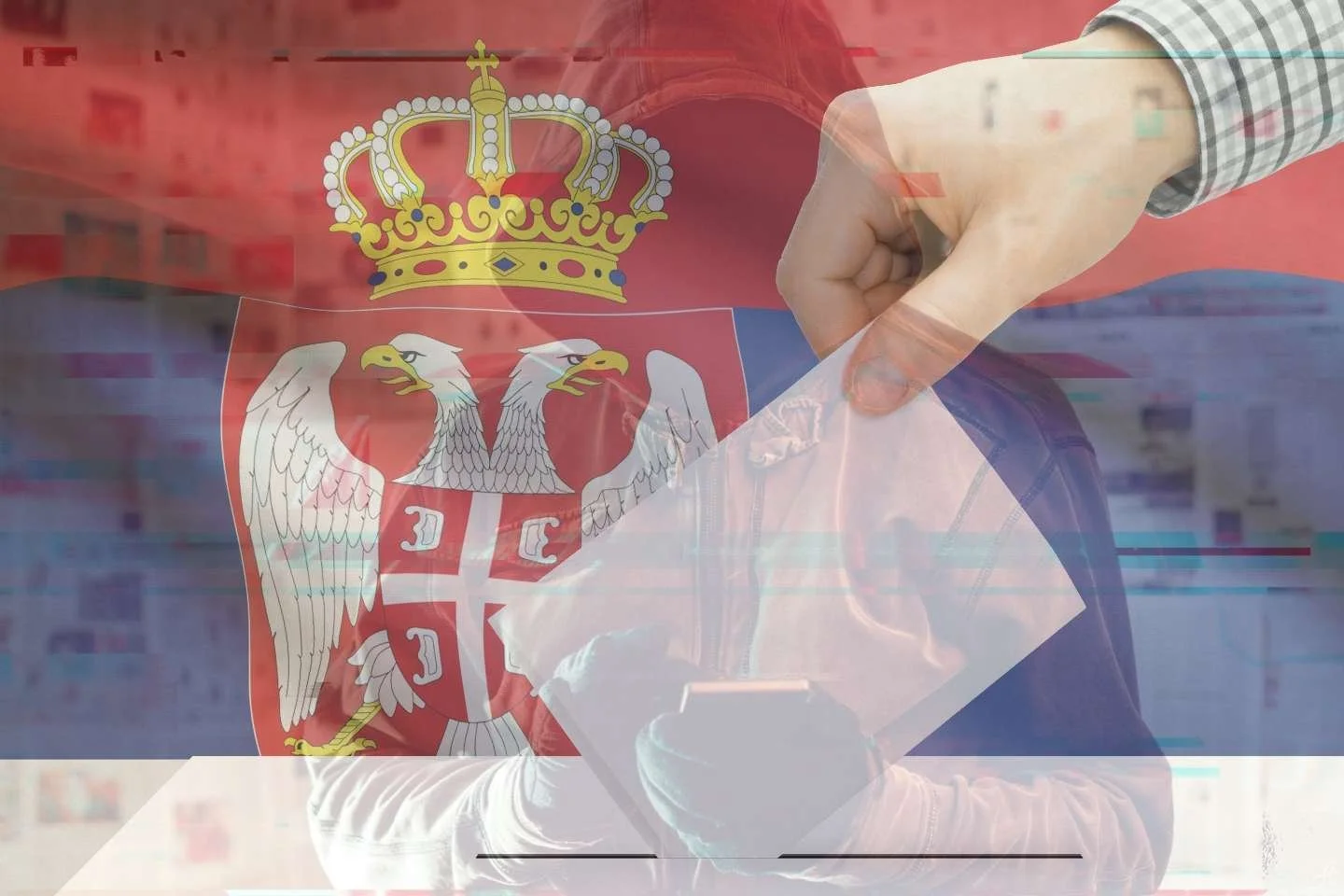
After fourteen years in power, Serbia's strongman still needs fake accounts to inflate his support and discredit the journalists who might point it out.
Europe has spent the past week watching students and workers take their anger over living costs and failing public services into the streets of France, Belgium, Italy, Portugal and Albania. Belgrade's pro-government press has covered the scenes with some relish, asking "whose hand is setting Europe on fire" and crediting Aleksandar Vučić with sparing Serbia a similar fate.
Serbians might be forgiven a wry smile. For almost two years, protesters across their country have halted traffic to stand in silence for sixteen minutes, one for each person killed when the concrete canopy of Novi Sad's newly renovated railway station collapsed in November 2024. On Sunday, the students who led that movement took on Vučić at the polls, in the most serious challenge of his rule, and won.
Vučić has spent those two years insisting that the protesters speak for a noisy few. Supporters have been bussed into Belgrade for rallies of his own. Online, the same work has fallen to several hundred fake accounts on X, documented in research published this week by the Balkan Free Media Initiative and Clemson University's Media Forensics Hub. Late on 4 October, twenty-four of them announced within two minutes, in identical words, that the student movement had "cracked".
The accounts rarely need to invent anything, since most of their material comes from Vučić himself. More than a third of their messages revolve around his own account, reposting and praising his posts in coordinated bursts until a few hundred profiles pass for the national mood.
For years, the debate about fake accounts has turned on whether they change votes. The evidence that they do remains thin, which may explain why the subject now draws more recognition than alarm. A network like this has no need to change minds when it can make a two-year protest look like a fringe and an entrenched incumbent look like the considered will of the nation. With polls divided and neither side expected to accept defeat easily, that impression was meant to matter most once the votes were counted. It wasn't enough.
N1 and Nova, the outlets Serbians trust most, have drawn the network's sustained hostility. Like the pro-government press, it treats both as an extension of the protest movement, so that the journalists covering the protests become one more party to them.
Offline, the season has been no kinder. Both channels broadcast on Luxembourg licences, beyond the reach of a Serbian regulator whose independence the European Commission has repeatedly questioned. Their new owner has now applied to bring them under that regulator's authority, as a government minister had publicly urged. The network insists these journalists belong to a political movement. Before long, they may have less freedom to show otherwise.
Europe's response to online manipulation has been shaped by fear of foreign interference. When such allegations engulfed Romania's 2024 presidential election, the result was annulled and Brussels opened proceedings against TikTok within weeks. Serbia, an EU candidate beyond the reach of the Digital Services Act, poses a harder question. A domestic network amplifying a governing party's own words fits none of the categories Europe has prepared.
The platforms have been left to manage the consequences alone. X has suspended about a fifth of the accounts during the campaign, yet only one of the 131 at the network's core. Twitter removed a network promoting Vučić in 2020 and Meta another in 2022, without ending the practice. Removing profiles does little to undo the impression they leave behind.
Europe now has angry streets of its own, with Spain, France, Italy and Poland all voting within about a year. In each, parties claiming to speak for a silent majority are in power or within reach of it. A network like the one supporting Vučić gives that claim something it has always lacked, a majority that can be produced on demand. Weeks before Serbia's campaign, BFMI found another in Bosnia and Herzegovina. The method is cheap and travels well.
Whatever else can be said of the crowds in Paris and Milan this week, every person in them existed. Brussels should have expected at least that much of the majority Vučić claimed on Sunday. It wasn't real enough to keep him in power.
Vanesa Valcheva is at the Balkan Free Media Initiative (BFMI). She holds an MSc in Russian and East European Studies from the University of Oxford.
Our readers read next: