False Chorus: Bosnia was the rehearsal. Serbia is the performance.
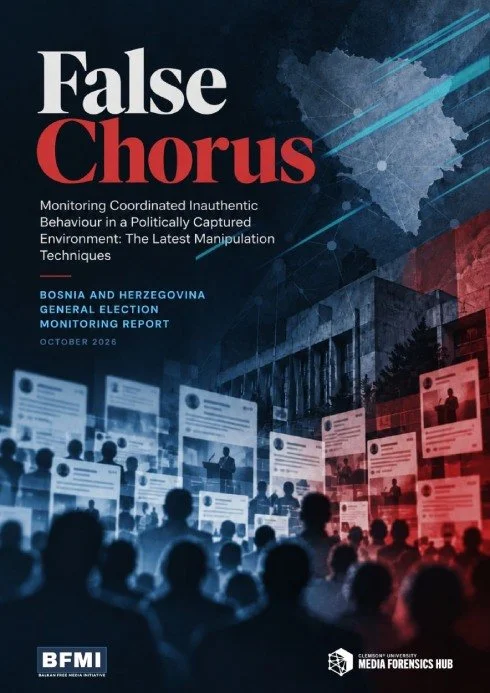
On 4 October, Bosnia and Herzegovina voted in what was billed as the most technically protected election in its history. Fingerprint readers and optical scanners made the count harder to cheat than ever before. The campaign that preceded it enjoyed no such protection. Our new report, False Chorus, produced with Clemson University’s Media Forensics Hub, documents a coordinated network of fake accounts that spent the campaign manufacturing support for the Alliance of Independent Social Democrats (SNSD), the party that has dominated Republika Srpska for most of the past two decades.
The network was not large. Around two dozen accounts on X, organised into ten separate clusters, and a further 49 matching personas on Facebook. What made it effective was not its size but where it chose to operate. Rather than build an audience from scratch, it borrowed one, repeatedly flooding the comment sections of established media outlets, including broadcasters with documented ties to the ruling establishment. A handful of operators could thus make support for the SNSD look widespread and spontaneous, while discrediting opponents and the very institutions administering the vote.
“This small cross-platform network of coordinated inauthentic accounts was quite targeted,” said Patrick Warren, Co-Director of the Media Forensics Hub. “It has been intervening for months in many local news conversations in Bosnia, especially in Republika Srpska, making pro-SNSD opinions and narratives seem more commonly held and more prominent than they would otherwise have been.”
From scale to structure
In Bulgaria earlier this year, our monitoring documented manipulation that relied on volume: hundreds of profiles, repurposed pages, engagement inflated by thousands of percent. Bosnia presented a different model. Its clusters were kept separate and mirrored across platforms, so that the loss of any single account leaves the rest intact. The lesson for anyone hoping to detect these operations is uncomfortable: there is no single signature to look for. The networks adapt to the political environment, the media landscape and the scrutiny they expect to face.
Why Bosnia is the prelude to Serbia
Serbia votes on 25 October, and the parallels are difficult to ignore. Our researchers found clear similarities with operations previously linked to Serbia’s ruling party. In February 2023, Meta removed more than 6,000 Facebook and Instagram accounts tied to the Serbian Progressive Party’s so-called Internet Team, which it said had been used to create “a perception of widespread and authentic grassroots support” for President Aleksandar Vučić and his party.
The political choreography is familiar too. On 27 September, Vučić resigned the presidency to run for prime minister. When CNN compared the move to Vladimir Putin’s exchange of offices with Dmitry Medvedev, Vučić pointed instead to Bulgaria: “Rumen Radev did this in an EU member state,” he said, referring to Radev’s resignation as president earlier this year and his return to power as prime minister. The manoeuvre has found its European precedent, and its defence. Four days after Vučić’s resignation, Putin told the Valdai Club that he hoped Vučić would be Serbia’s next prime minister, praising Belgrade’s “desire for cooperation with Russia”. Three weeks before the vote, the Kremlin had already stated its preferred result.
Has the EU’s carrot lost its taste?
For two decades, Brussels has offered the Western Balkans the prospect of membership in exchange for reform. Both Bosnia and Serbia are candidate countries. Both receive substantial EU funding. Yet in both, the promise of accession has lost much of its pull on public opinion, and the EU’s essentially technocratic approach has done little to win back the hearts it has lost. Into that space, other narratives move freely, carried in part by the networks our report documents.
The regulatory picture compounds the problem. As candidate countries, neither Bosnia nor Serbia falls under the Digital Services Act. No national authority in either country has the power to hold the platforms to account for systemic election risks. Neither X nor Meta has publicly reported any action against coordinated inauthentic behaviour linked to Bosnia’s election. In Bulgaria, TikTok closed 34 accounts after our tracker flagged them. The question now is whether Meta and X will act before Serbia votes, or whether the gap between documented evidence and platform response will once again prove the defining feature of the campaign.
Why Western Europe should be paying attention
With this week’s headlines dominated by Spain and Brazil, a small Balkan country can seem a long way from the centre of European concern. It should not. Germany has just had its own cold shower, with the AfD winning the regional election in Saxony-Anhalt in September. Spain, France and Italy, three pillars of the eurozone, all face national elections by 2027. The techniques being refined in Banja Luka and Belgrade today are not confined to the Balkans. They travel, adapt and reappear, and Europe would do well to study them while they are still small enough to see clearly.
“Bosnia should not be treated as a peripheral election,” said Antoinette Nikolova, Director of BFMI. “What happens in the Western Balkans is an early warning for Europe, and with Serbia voting in less than three weeks, platforms and EU institutions need to be paying attention now.”
BFMI and the Media Forensics Hub will monitor the Serbian campaign through to polling day and beyond, and will publish our findings as the election unfolds.
Our readers read next: